For agencies and studios
Client apps your agents build, with the paperwork done
AALY lets software and digital agencies build and host client apps with the coding agents the team already uses: Claude Code, Cursor, Codex and more. Your agents get a method to follow and a backend to build on, with no AI credits to buy. Each client gets a working app at its own address and the documents you'd otherwise write by hand: a spec they approved, a test report and a user guide.
What a client receives
The agent writes these as it works, phase by phase, and saves them with the client's project. They are written for the client, not for engineers: no field names, no tool names, no JSON.
The spec
Problem, goals, roles, features with acceptance criteria, screens and numbered business rules, in the client's own words. Approval is recorded with their exact reply and the date.
Hard-to-change decisions
The choices that cost a migration to undo later, like how the client's locations are separated or which lists can be filtered, explained in plain words and signed off before anything is created.
The test report
Each rule is checked against sample data on the real API in the project's test customer account (tenant), plus a smoke run on the live address. Each result carries its evidence.
The user guide
Written for the client's front desk: the link, the owner's first sign-in, how staff and customers get in, each screen step by step, and the next steps.
Because the documents live in the project, a change request six months later starts from them. Whichever agent picks it up, yours or the client's, reads the spec and the test report first, writes a new version of the spec for the change, and re-runs the checks.
Scoping that feels like working with an architect
The agent runs discovery the way a senior consultant would: plain questions, about three at a time, each with a sensible default, plus ideas the client may not have thought of. It maps every requirement to how it will be built on AALY, writes the spec, and lists the decisions that are hard to change later so the client signs them off while they are still cheap. Your team stays in control of the scope, and the client sees a clear plan before anything is built.
One account, a project per client
Each AALY project is its own app: its own data model, data, API, site and customers. They sit under one account so your team reaches all of them, and nothing is shared between them that shouldn't be.
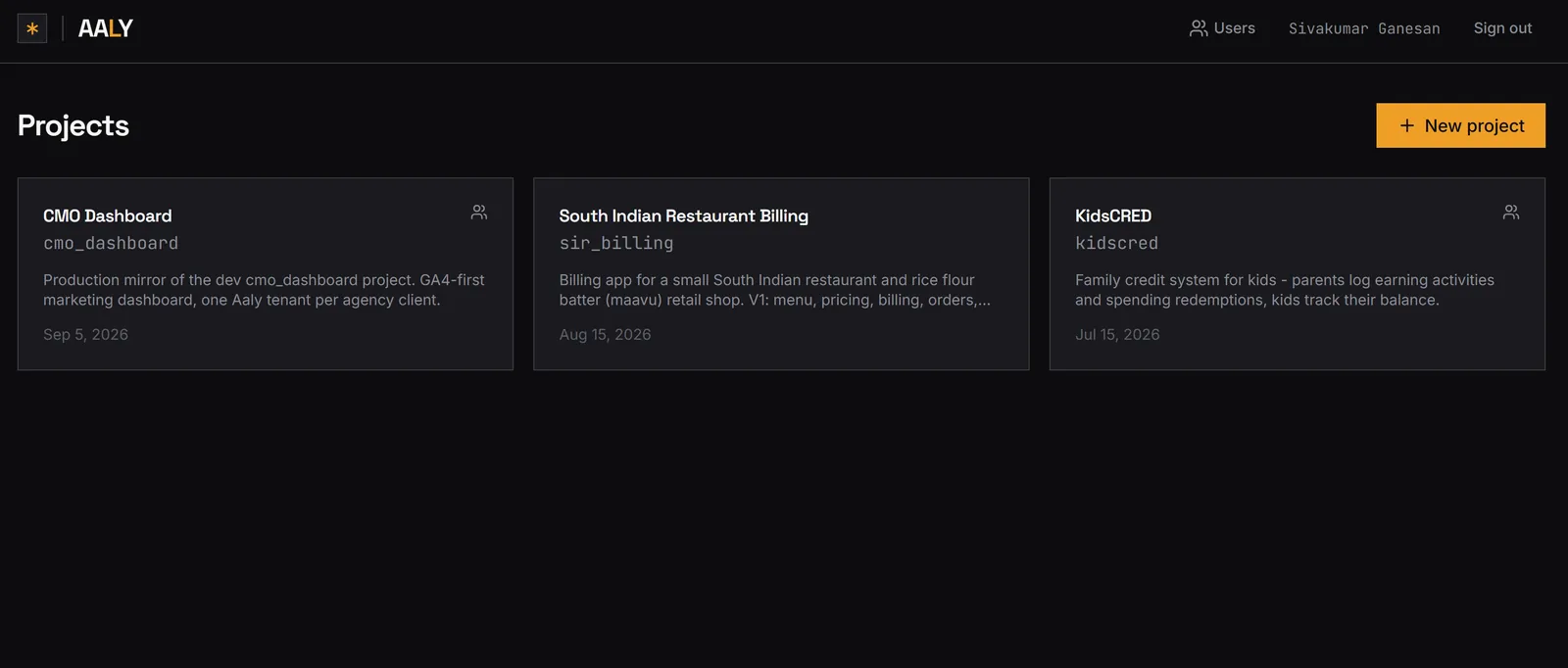
Every project starts with two customer accounts: a test one, where the agent seeds sample data and runs its checks, and a live one for the client's real business. If the client runs several businesses, each gets its own live customer account. If what you're building is itself a product that other businesses sign up to, each business can get its own space on sign-up. Keeping them apart is done by the platform, not by policies your agents have to write. How isolation works →
Handing it over
The backend is a definition that AALY runs, so there is no backend codebase to hand over, review, or get called about later. The frontend is ordinary code your agent wrote, and the user guide says where it lives so the client keeps a copy. When they want a field added next year, their own developer or agent changes the definition and re-runs the checks in the test report to see whether anything else moved.
A project's live customer account starts with whoever created the project as its first user. For a client, your agent can set up the client's business as a live customer account with the client's owner as its first user, or add them from inside the app. The user guide walks them through their first sign-in.
Billed on what the apps use
There is no per-seat billing. Invite the whole studio, the client, the contractor you brought on for six weeks, and every coding agent any of them runs. None of that changes the invoice, because the meters are requests and events, projects, customers and storage. AALY sells no AI, so your agents' work isn't metered here either.
For a studio with many clients
Medium, $500/mo
100 projects, 500 customers, 5M requests and events a month, 200 GB storage. Need more? Move up a band; the price is the price.
Every band →Questions people ask
- Can my agency build client apps with Claude Code or Cursor?
- Yes. AALY connects to Claude Code, Cursor, Codex and any other MCP client, and gives your team's agents a backend, hosting and a build method for client work. Each client app gets its own project, with sign-in, file storage, notifications and hosting at its own name.aaly.cloud address.
- How do I build a client portal for my agency with AI?
- Connect your coding agent to AALY and describe the portal the client needs. The agent asks scoping questions, writes a spec the client approves, builds the backend and the frontend, checks each rule against sample data and publishes the portal with a user guide for the client's staff.
- Does AALY charge per seat?
- No. AALY has no per-seat billing and sells no AI credits. Your whole team, your clients and every coding agent can work on a project, and the bill is based on requests and events, projects, customers and storage.
- How is each client's data kept separate?
- Each client is its own AALY project, with its own data model, data, API and site. Inside a project, AALY scopes every request to one organisation (a tenant), so if a client runs several businesses, or its app has customers of its own, each one's data is kept apart by the platform.
- Can the client take the app over later?
- Yes. The frontend is ordinary code the client keeps, and the backend is a definition AALY runs, described by a live OpenAPI spec. The spec, test report and user guide are saved with the project, so any developer or agent the client brings in can pick it up from there.
Try it on the next build.
Solo is free for the first 3 months, then $10 a month. It carries 2 projects, 10 customers, 4 GB and 100k requests+events a month, which is enough to put a real app in front of a real client. Test customers are free and never count toward your customers.
Start building